
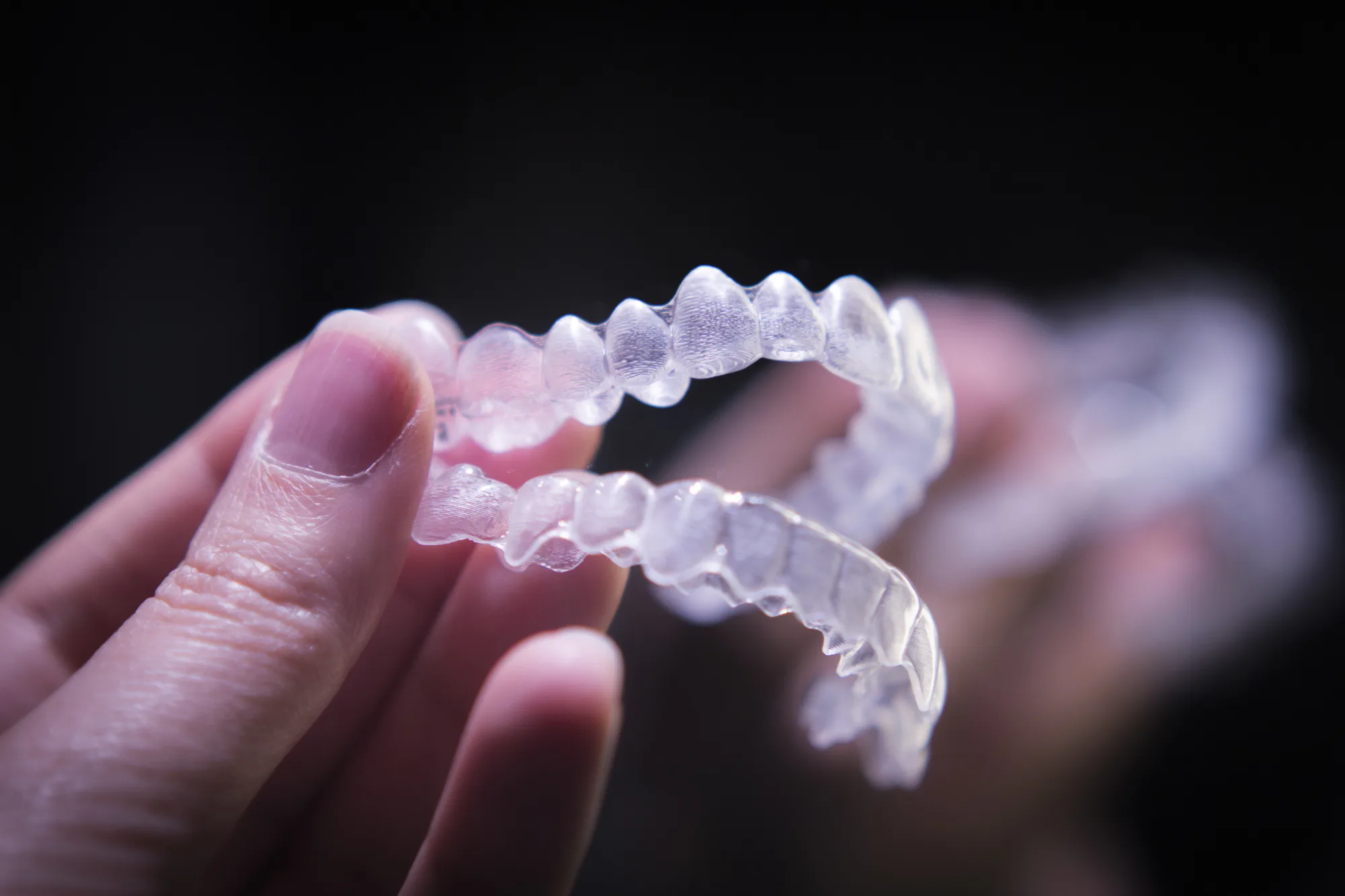
Quick answer: No, it is not safe to order aligners (an invisible brace) without a physical examination by an orthodontist. Without an assessment of your tooth roots, jawbone and bite, an incorrect tooth movement can lead to permanent damage: loose teeth, receding gums and a disturbed bite. An orthodontist screens, makes a plan and adjusts during the treatment.
Introduction
These days you can order a set of aligners online, take an impression at home and start a treatment without ever seeing an orthodontist. Tempting in terms of price and convenience, but the short answer to the question "is that safe?" is no. An aligner moves real teeth through real jawbone, and what you cannot see or feel can go irreversibly wrong.
On this page you can read exactly which risks you run without a physical screening, what an orthodontist actually does before and while your teeth move, and how you work on a beautiful smile responsibly. We write this from the daily practice of our orthodontic clinic in the centre of Amsterdam, on the Museumplein.
What exactly are aligners?
Aligners are a series of transparent, removable plastic trays that click over your teeth. Each tray moves your teeth a small step; every few weeks you switch to the next one. Together they form an invisible brace: an orthodontic treatment without visible brackets or braces wires.
The important detail that often disappears in advertising: an aligner is not a cosmetic product like a whitening strip. It is a medical device that moves teeth and roots through bone. That can go beautifully, provided someone with the right training first assesses whether your teeth and jaw can handle that movement, and keeps following the process.
Aligners without a physical examination: these are the risks
With treatments without a physical screening, precisely what makes the treatment safe is missing: an orthodontist who examines your mouth in real life. An impression or photo you take at home does not show what is happening under the gums and in the bone. The main risks:
- Irreversible damage to tooth roots. Forces that are too fast or wrongly directed can dissolve the root tip (root resorption). A shortened root does not grow back.
- Receding gums and bone loss. Teeth pushed outside the bone can cause gum recession and permanent bone loss, sometimes visible as longer teeth or gaps.
- Loose or painful teeth. Forces on a set of teeth with hidden problems (think of an infection under a molar or beginning cavities) can make teeth loose or painful.
- A disturbed bite. Straightening front teeth nicely without looking at the bite can disturb your chewing function and cause jaw joint complaints.
- A missed diagnosis. An unnoticed infection, periodontitis (gum disease with bone loss) or an unerupted tooth is simply not seen via an online route, while moving teeth can make those problems worse.
Professional associations of orthodontists warn explicitly about this: home treatments without professional supervision increase the chance of incorrect tooth movement and therefore of permanent tooth and bone damage. The fact that demand for an invisible brace among adults keeps rising only makes the temptation of a cheap online route greater, and therefore the risk more relevant.
What does an orthodontist actually do? The full process
The difference is not in the tray itself, but in everything around it. This is how a responsible aligner treatment proceeds step by step:
- Intake and oral examination. The orthodontist looks at your teeth, gums and bite in real life and asks about complaints and your medical background.
- 3D scan and X-rays. With a digital 3D scan and X-ray images the orthodontist assesses the position of your tooth roots, the amount of jawbone and the health underneath: information you can never gather yourself at home.
- Bite assessment. How do your teeth meet? An open bite, crossbite or overbite requires a different approach than just straightening front teeth.
- Tailored treatment plan. Based on the findings it is determined whether aligners are suitable, how many trays are needed and which teeth may move how far, within safe limits.
- Interim check-ups. During the treatment the orthodontist checks whether the teeth are moving as planned and adjusts where necessary. If a tooth does not move along, or a problem arises, the practitioner intervenes in time.
- Aftercare and retention. After the treatment the result must be held in place. In our practice we do that with a removable retainer (night retainer); without that aftercare, teeth almost always shift back.
Steps 2, 3 and 5 are precisely what an online route without a physical examination skips, and that is exactly where the safety lies.
How do you recognise an unsafe route?
Unsure about an offer? Watch out for these signals. The more that apply, the greater the risk:
- You take an impression or scan yourself at home, without an orthodontist seeing your mouth in real life.
- No X-rays are taken before the treatment starts.
- Your bite and gum health are not assessed.
- There is no fixed practitioner who checks you in between and can adjust.
- Contact only goes via an app or form, not via a physical consultation.
A safe treatment revolves around an orthodontist who knows your teeth and keeps following them, not a product that arrives by post.
What does a responsible aligner treatment cost?
Being honest about money is part of it. An aligner treatment with an orthodontist usually costs several thousand euros in the Netherlands, depending on the complexity and the number of trays. Online providers look cheaper, but that price includes no screening, no monitoring and no safety net if things go wrong. The cost of repairing damage (think of gum treatment, a root canal treatment or even loss of a tooth) is many times higher than the difference you save upfront.
With us you receive a clear cost overview in advance, so you know where you stand. Want to know what a brace or invisible brace costs? Read our blog about the cost of a brace.
Why choose Orthodontie Museumplein?
Our practice is in the centre of Amsterdam, within walking distance of the Museumplein. We treat both children and adults and guide you from the first scan through to the aftercare, not a treatment you go through on your own at home. What you can expect from us:
- A real screening before anything moves. 3D scan, X-rays and a bite assessment, so we know whether aligners are safe and worthwhile for your teeth.
- Guidance throughout the whole process. Regular check-ups in which we follow progress and adjust where necessary.
- Clear aftercare. After the treatment we work with a removable retainer to hold the result in place, with a clear cost overview in advance.
- Easy to reach. Easily accessible by tram, bike or car from all over Amsterdam and the surrounding area.
Not sure whether aligners are right for you, or have you already ordered something online and want a professional assessment? Plan a no-obligation consultation at our practice in central Amsterdam.
Frequently asked questions
Can I safely order aligners without going to an orthodontist?
No. Without a physical screening of your tooth roots, jawbone and bite, an incorrect tooth movement can cause irreversible damage, such as root resorption, receding gums and loose teeth. An orthodontist assesses your teeth, makes a plan and adjusts during the treatment.
Why are X-rays and a 3D scan so important?
They show what you can never see yourself: the length and position of your tooth roots, the amount of jawbone and any hidden infections. Moving teeth without that information is gambling with a permanent result.
What if I have already ordered aligners online?
Stop wearing them if you have complaints (pain, loose teeth, bleeding gums) and plan a check-up. We assess with a scan and X-rays what has happened and whether it is safe to continue, and how.
Are aligners less effective than a fixed brace?
Not necessarily. For many alignment corrections aligners work excellently, provided they are planned and followed by an orthodontist. For more complex cases a fixed brace may be more suitable. What fits best depends on your teeth and bite.
How do I keep the result after treatment?
With retention. In our practice we work with a removable retainer (night retainer) that you wear after the treatment. Without that aftercare the teeth almost always shift back slowly.
Want to know more or request a no-obligation consultation? Contact our practice in Amsterdam.