
Quick answer: "Turkey teeth" is the nickname for a sleek, white row of teeth made in a short time with crowns or veneers. To achieve this, healthy teeth are ground down considerably, and that is irreversible. In the long run, this can cause sensitivity, inflammation or a dead nerve. If your teeth are only crooked, braces move them without any grinding.
Introduction
Someone leaves with an ordinary set of teeth and comes back a week later with twenty perfectly straight, brilliant white teeth, for less than you would pay here for a single crown. What those images don't show is what happened to their own teeth in the meantime.
That is what this article is about. Not about where you go, but about what the treatment itself does to your teeth, and whether you need that procedure for the result you are looking for. We write from our orthodontic practice in central Amsterdam.
What does "turkey teeth" mean?
Turkey teeth is not a treatment and not a professional term, but a social media nickname for a look: an even, bright white row of teeth in which all the teeth seem equally wide and equally long. That effect does not come from your own teeth being straightened, but from crowns or veneers being made to fit over them. What you see is a shell. And that shell has to fit onto something.
The KNMT, the professional association of dentists in the Netherlands, is not in favour of dental travel abroad, and explicitly adds that this is not because the care there would be poor, but because problems can arise with aftercare and guarantees. That is our approach too. Good practitioners can be found everywhere. The question that matters is which procedure is carried out.
For a sleek row, healthy teeth go under the drill
To place a crown over a tooth, that tooth has to be made smaller. Material is ground away all the way round so that the crown fits over it. What is left is a stump.
How much is removed? In laboratory research in which the prepared teeth were weighed, a full crown removed about 63 to 72 per cent of the visible crown of the tooth (Edelhoff and Sorensen, Journal of Prosthetic Dentistry, 2002). Roughly two thirds of what you see in the mirror. With veneers, which only cover the front, it was less: about 3 to 30 per cent. Two caveats: that research was done on plastic model teeth, and today's materials can make do with less. But even then, something is removed.
And that is the crux. Enamel does not grow back. The American Dental Association (ADA) states plainly about veneers that the treatment is not reversible, precisely because enamel is removed. For a crown, this applies even more. You can change your mind later about the colour or the practitioner, but not about your own tooth tissue. From that moment on, you will always need a crown in that spot.
What you may run into over time
A ground-down tooth reacts differently. Not in everyone and usually not straight away, but these are the known risks:
- Sensitivity. Beneath the enamel lies dentine, which is connected to the nerve. Right after grinding, teeth are often sensitive to cold and heat. For most people, this fades again.
- Gums that react. The edge of a crown often sits just below the gum line, and that spot is harder to keep clean. Good oral hygiene can deal with this, but it asks more of you than a natural tooth does.
- A nerve that dies. In a review pooling 37 studies, the nerve eventually died in about 5 per cent of treated teeth (Al-Manei et al., BMC Oral Health, 2023), and in studies with a follow-up of ten years or more, the figure is higher. A root canal treatment then follows. This often happens without pain, so you only find out at a check-up or on an X-ray.
- Crowns don't last forever. In a large British practice-based study of almost 50,000 crowns, 68 per cent of metal crowns were still in place after ten years without retreatment, compared with about half of porcelain crowns (Burke and Lucarotti, Journal of Dentistry, 2009). Every replacement is a new procedure on the same tooth, which by then is smaller.
What you pay now is not the final price, but the first instalment.
Aftercare is harder to arrange if the treatment was done elsewhere
If a crown comes loose or the gums stay inflamed, the practitioner who made it is in principle responsible for the aftercare. If that practitioner is a flight away, this is difficult. The KNMT notes that, as a result, care for complications regularly ends up with the patient's own dentist in the Netherlands, that it is quite often unclear which materials were used, and that patients who are treated abroad cannot fall back on the rights they do have here.
If you do go, do this:
- Request your records, with X-rays and the materials used. Without that information, a practitioner here is working blind.
- Work out what repairs cost. For adults, crowns and veneers are not covered by basic health insurance, and so neither are repairs to them. What supplementary insurance covers differs per policy.
- Discuss your plan with your dentist beforehand.
Crooked teeth or a small gap? Usually nothing needs to be removed
Many people who are considering crowns have healthy teeth that simply aren't neatly aligned: a tooth that sits slightly forward, a slight overlap, a small gap. For that, there is a route in which nothing has to come off your teeth.
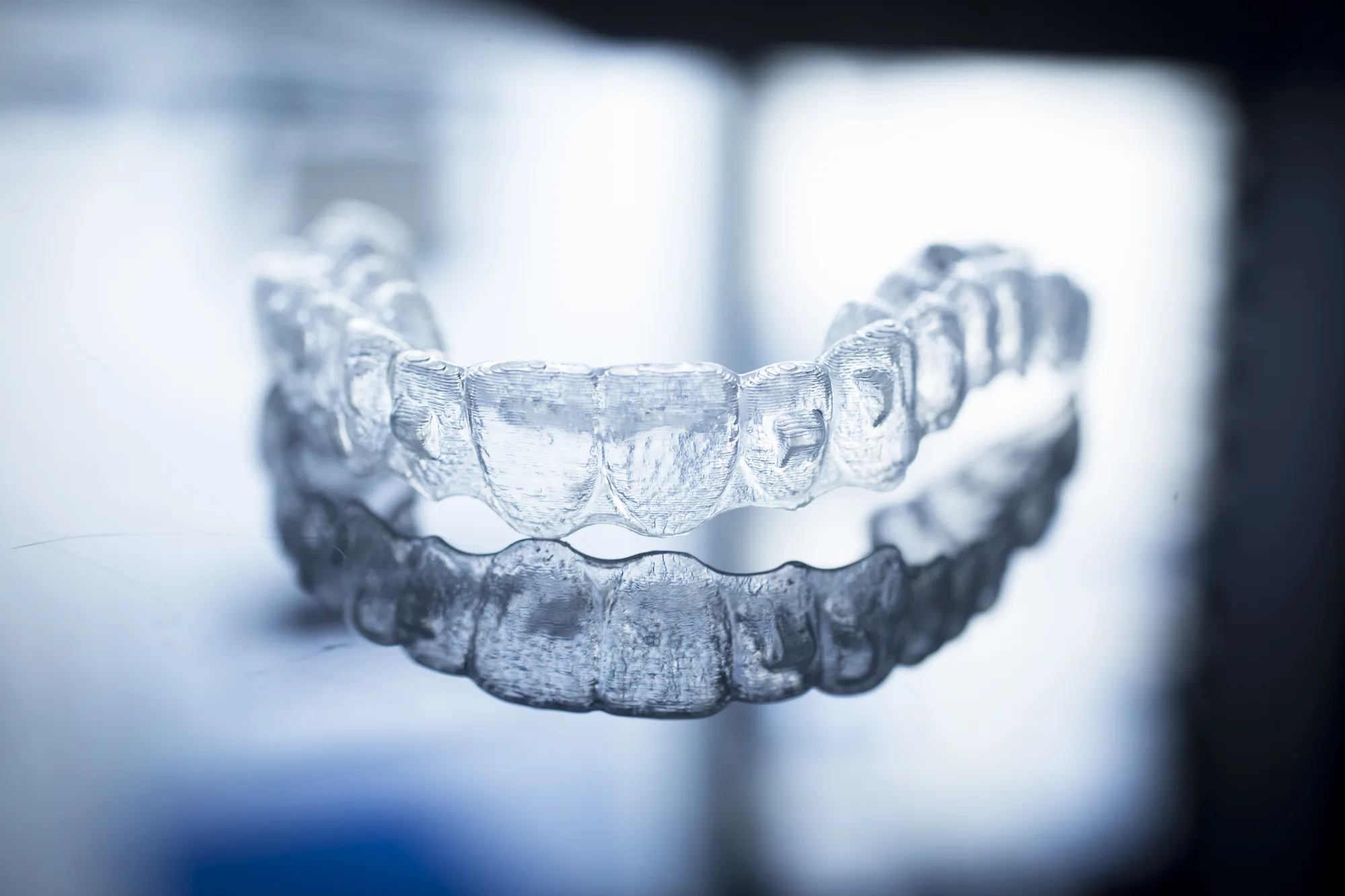
Orthodontic treatment does not change your teeth, it moves them. Under a light, sustained force, the bone around the root breaks down on one side and builds up again on the other. The tooth moves along with it, root and all. Nothing is taken away from the tooth itself. What you see at the end is your own enamel, just in a better position. This can be done with Invisalign aligners or another type of invisible braces, and for more difficult corrections with fixed braces. All the options are listed on types of braces for straightening teeth and on braces for adults.
There is one nuance to add. If your teeth are very crowded, a very thin layer of enamel is sometimes removed between two teeth to create space. This is called interproximal reduction and involves something in the order of a quarter of a millimetre per surface, compared with two thirds of the crown of the tooth when fitting a crown. Research shows that, when done carefully, this does not lead to extra cavities or gum problems. So it is not nothing, but it is a different order of magnitude.
Braces have downsides too
Around brackets, enamel can decalcify into white spots if brushing falls short. The tip of the root can become slightly shorter, usually only a little and without consequences, and we monitor this with X-rays. And teeth want to move back, so a retainer is part of every treatment. See risks and inconveniences. You should be given that information before you choose, and that goes for crowns too.
Why choose Orthodontie Museumplein?
Our practice is in Amsterdam, within walking distance of Museumplein, and treats children and adults. Lotte Meereboer is a dentist specialising in orthodontics (Drs. MSc Orthodontics) and the face of the practice: see the page about Lotte Meereboer and our clinic at Museumplein.
- We first look at what you want to change. If it is about the position of your teeth, we move them. If it is about colour or shape, we refer you to a dentist.
- As little irreversible treatment as possible. What you still have, you keep. That is not only our starting point, it is also set out in the Dutch quality framework for cosmetic dental care.
- Clarity about the plan and costs in advance. What braces roughly cost and how reimbursement works is explained on the cost of braces. A no-obligation consultation commits you to nothing, and that includes coming in with questions about a treatment abroad.
Frequently asked questions
Are healthy teeth really ground down for "turkey teeth"?
Yes, that is part of the method. To place a crown over a tooth, that tooth has to be made smaller. In laboratory research, a full crown meant removing about two thirds of the visible crown of the tooth. With veneers it is less, but enamel is still removed.
Can the grinding be undone?
No. Tooth tissue that has been ground away does not grow back. You will then always need a crown or veneer in that spot. It can be replaced, though, and at some point that will be necessary.
Can crooked teeth also be straightened without grinding?
In many cases, yes. Braces or aligners move your own teeth, root and all, without removing any tooth tissue. Only when space is tight is a thin layer sometimes removed between the teeth. What is possible in your situation becomes clear from an examination of your teeth, jaw and bite.
What if something goes wrong with work done abroad?
The practitioner who did the work is in principle responsible for the aftercare. If that is not practically feasible, you end up with a dentist here, who has to work blind without your records. So always ask for your records and X-rays.
Torn between crowns and straightening your own teeth? Book a no-obligation consultation at our practice in central Amsterdam.